Title: Medical Teachers’ Entrustable Professional Activities for Clinical Education
Link: https://B2n.ir/yd9368
Post in Linkedin:
MAIN CONTENT:
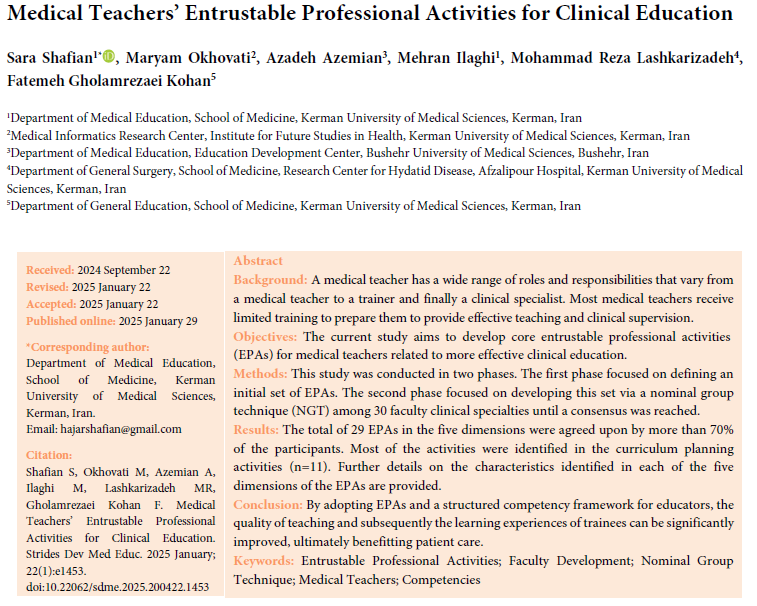
For years, medical professors have faced a challenging reality: while they're experts in their medical specialties, many receive minimal training on how to effectively teach the next generation of doctors. This gap in teaching preparation has now been addressed through a comprehensive research study involving clinical specialists across multiple medical fields.
The research team developed what they call "Entrustable Professional Activities" – essentially a practical checklist of teaching skills that medical educators need to master. Think of it as a roadmap for what makes a great medical teacher, broken down into measurable, achievable skills.
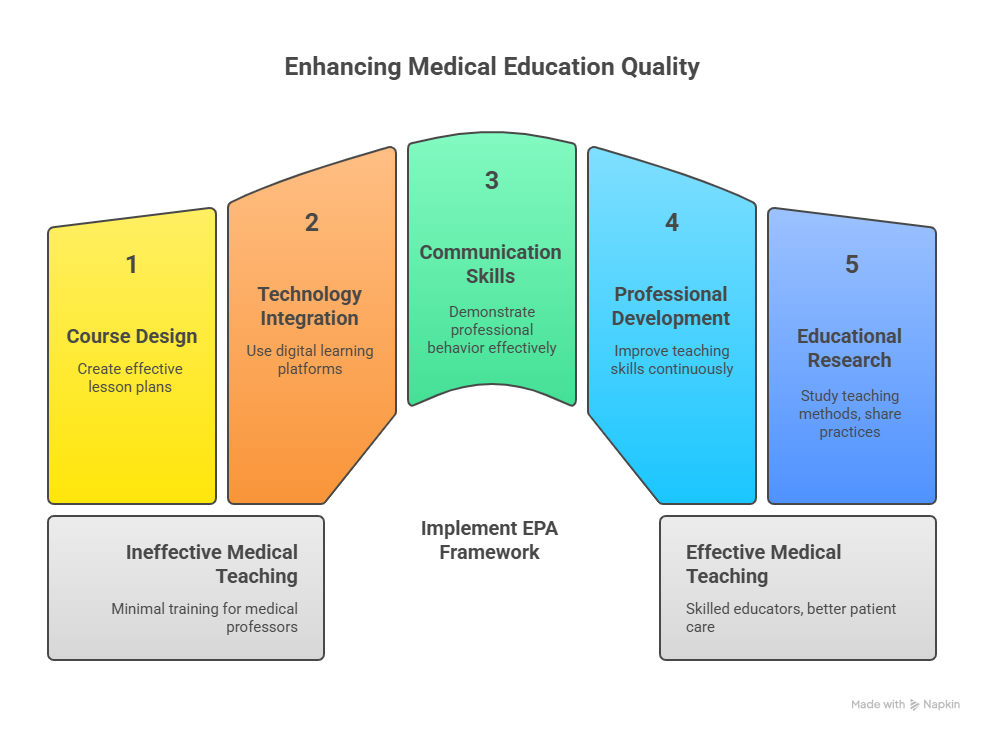
The framework identifies five key areas where medical teachers need expertise:
-
Course Design and Planning – Creating effective lesson plans and choosing the right teaching methods for different situations
-
Technology Integration – Using modern tools like digital learning platforms and virtual reality in teaching
-
Communication and Role Modeling – Demonstrating professional behavior and mentoring students effectively
-
Professional Development – Continuously improving their own teaching skills and medical knowledge
-
Educational Research – Studying teaching methods and sharing best practices with colleagues
"What makes this approach revolutionary," explained one researcher, "is that it provides clear, observable teaching skills that can be assessed and improved upon. Rather than assuming good teachers are born, not made, we're showing that great teaching can be systematically developed."
SIGNIFICANCE AND IMPACT:
This research comes at a critical time when healthcare systems worldwide face increasing demands for highly skilled doctors. The framework offers medical schools a practical tool to ensure their professors are not just medical experts, but also effective educators.
Hospitals and medical schools can use this system to
-
Provide targeted training for their teaching staff
-
Assess teaching effectiveness objectively
-
Ensure consistent quality in medical education
-
Ultimately improve patient care through better-trained doctors
CONCLUSION:
As one education specialist noted, "When we improve how we train medical teachers, we enhance how students learn, which ultimately translates to better patient care. This isn't just about education – it's about creating a ripple effect that reaches hospital bedsides and improves healthcare outcomes for everyone."
The study represents a significant step toward ensuring that the doctors of tomorrow learn from professors who are not only medical experts but also skilled educators – potentially transforming medical education and patient care for generations to come.
Post in x:
To improve clinical education and patient care, medical teachers need structured training and assessment in core teaching competencies, not just medical expertise.
The effectiveness of teaching complementary and alternative medicine based on the components of theory of planned behavior on nutrition students: multicenter research study
link: https://B2n.ir/tr3915
:Post in Linkedin
:MAIN CONTENT
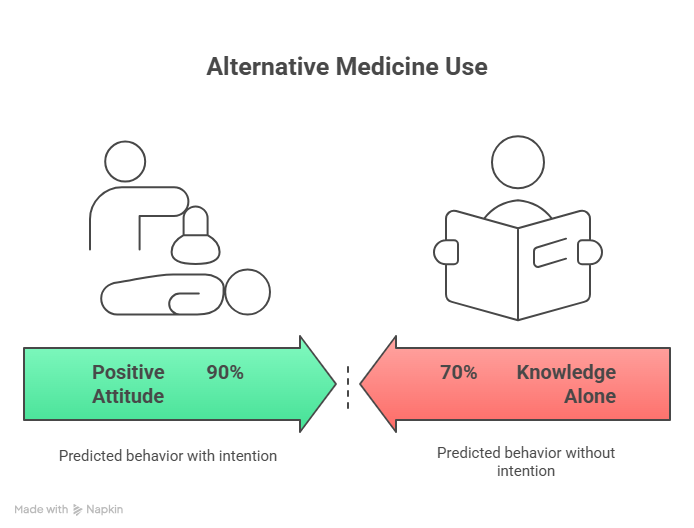
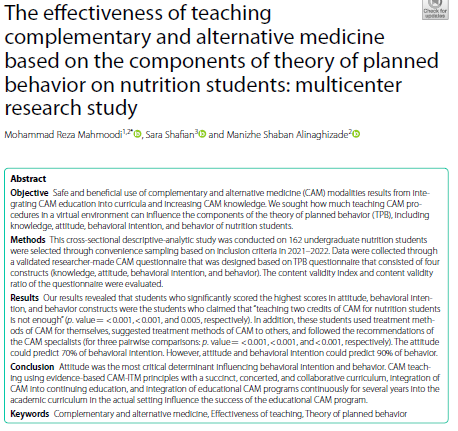
A study of 162 nutrition students across Iran found that those who believed their two-credit complementary and alternative medicine (CAM) course was insufficient showed significantly more positive attitudes, stronger intentions to use these therapies, and were more likely to actually recommend them. These students were also more inclined to use CAM treatments themselves.
The research revealed that attitude alone predicted 70% of a student's intention to use alternative medicine. When combined with behavioral intention, it predicted a remarkable 90% of their actual behavior—far outweighing the role of knowledge alone.
Current CAM education faces challenges like insufficient scientific evidence and limited trained professionals. Students requested more continuous education integrated throughout their curriculum, taught by nutrition professors, with opportunities to interact with practicing CAM specialists.
:CONCLUSION
As patients increasingly seek integrative healthcare, this study suggests that effectively training future providers requires more than brief courses—it demands building positive attitudes through sustained, well-designed education that prepares them for real-world patient needs.
:Post in x
A positive attitude, more than knowledge alone, is the strongest factor determining whether healthcare students will use and recommend complementary medicine, requiring educational programs that build confidence through sustained integration.
Explaining the Residents’Perception of Desirable Clinical Education: A Qualitative Content Analysis
Link: https://B2n.ir/nm3127
:Post in Linkedin
:Main Content
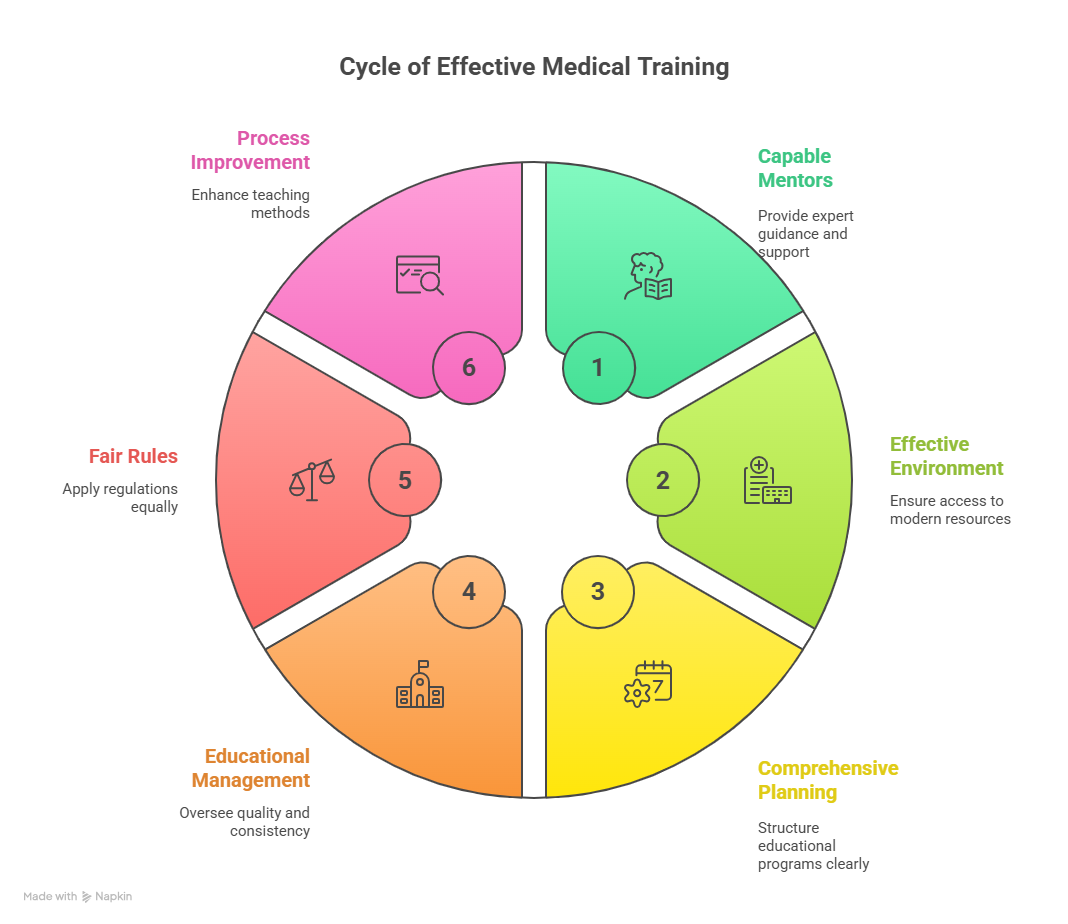
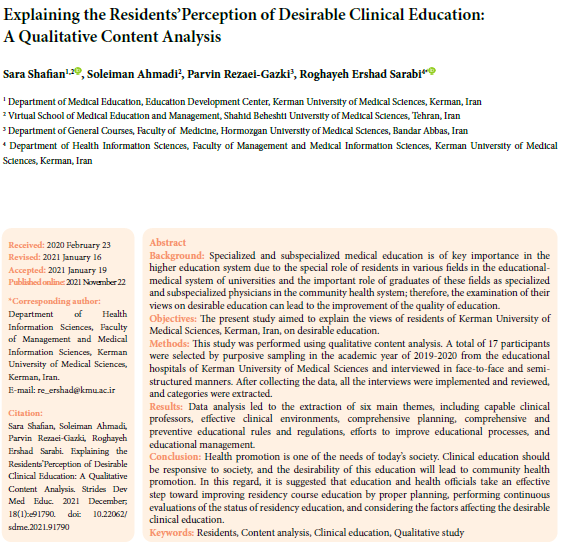
The qualitative study, based on in-depth interviews with 17 residents, identified six key pillars for successful medical training.
First and foremost, residents emphasized the need for capable clinical professors. These are mentors who are not only experts in their field but are also present, supportive, and dedicated to teaching, rather than being overburdened with administrative tasks.
Secondly, the study highlighted the importance of an effective clinical environment. This means having access to modern equipment and technology and, crucially, knowing how to use them properly for learning.
Other critical factors include comprehensive planning—having a clear, structured educational program so residents know what to expect and when—and strong educational management from university officials to ensure consistent quality and oversight.
Finally, the research pointed to the need for fair and clear rules applied equally to all, and continuous efforts to improve educational processes, such as making teaching rounds and morning reports more learning-focused.
:Conclusion
The significance of this research extends far beyond the classroom. By outlining what residents need to thrive, it provides a clear blueprint for medical schools and hospitals to improve training programs. Ultimately, investing in better clinical education doesn't just create better doctors—it leads to better, safer patient care for everyone, strengthening the entire healthcare system. The study reminds us that the quality of our future healthcare depends on the quality of training we provide today.
:Post in x
Improving medical residency training by focusing on key areas like professor quality, learning environments, and strong management is essential for developing skilled doctors and enhancing patient care for everyone.
Retention of physiology knowledge among medical students in basic science: a cross-sectional study
link: https://B2n.ir/rz1192
:Post in Linkedin
:MAIN CONTENT
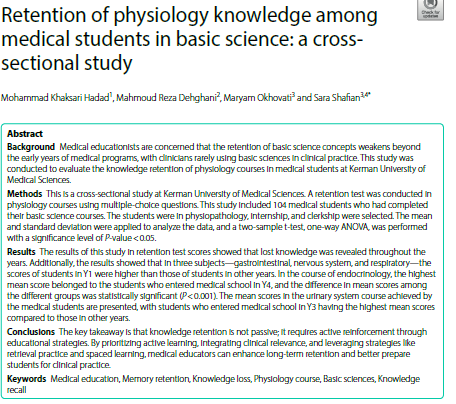
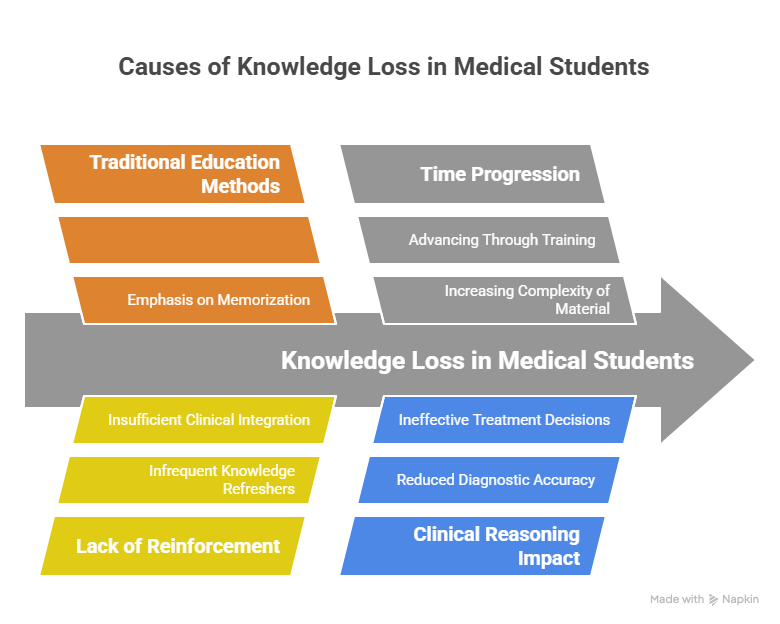
A study tracking 104 medical students found significant knowledge loss in core physiology subjects like gastrointestinal, cardiovascular and nervous systems. Students tested on material they had previously mastered showed declining scores as they advanced through their training, demonstrating that without active reinforcement, even critically important medical knowledge fades over time.
The research suggests that traditional medical education methods, which often emphasize memorization, may be insufficient for long-term retention. This knowledge erosion occurs precisely when students need these scientific foundations most—as they begin diagnosing and treating patients.
:SIGNIFICANCE
This finding matters because physiology knowledge forms the basis for clinical reasoning and accurate diagnosis. When doctors forget these fundamental principles, it could potentially affect their ability to understand complex medical cases and make informed treatment decisions.
:CONCLUSION
The study recommends educational reforms including regular knowledge refreshers, practical applications of scientific concepts, and better integration of basic science with clinical training. These changes could help ensure that future doctors retain the essential knowledge needed to provide high-quality patient care throughout their careers.
:Post in x
Medical students significantly lose essential physiology knowledge over time without active reinforcement, necessitating educational reforms that integrate continuous clinical application and retrieval practice for long-term retention.